


SECRETS OF THE AGORA: AMERICAN SCHOOL OF CLASSICAL STUDIES '60s–'70s EXCAVATIONS

When we are young, we all have different plans and dreams — cowboy, princess, astronaut, and so on. Many of us also enjoy digging in the backyard, searching for arrowheads, dinosaur bones, or treasure. Most leave these childhood pleasures behind and lead productive lives. A few don’t, and they keep digging, eventually becoming archaeologists.
I began digging in the Agora of Athens in my second year of college. I wasn’t supposed to be there, but in my letter I said I was in my second year at Harvard. Homer Thompson, director of the Agora, assumed I was a second–year graduate student, not an undergraduate. Once I had a foot in the door, I was hard to remove.
The Agora was the city’s public square, used for many purposes: one day a market, the next an election site, a religious procession, a theatrical event, or even an ostracism to exile a politician. Whenever citizens needed a gathering place, its large open space was available. Along its edges stood essential public buildings: the senate building, archives, bureau of standards, mint, magistrates’ offices, and lawcourts. If you want beautiful temples and art, you dig sanctuaries. If you want history, you dig the Agora — the political, commercial, and social heart of every Greek city.
I started in 1966, assigned eight to 10 workmen to direct, and shown where to dig. I received old notebooks to study, learned how records should look, was told to learn modern Greek, and twice a day Homer came to comment, advise, and teach me to date pottery. It was hot, dusty work from 7:30 a.m. to 5 p.m. I lived in a pension for 100 drachmas a day, meals included. With no metro, I walked 40 minutes to work and back.
In the late 1960s and early 1970s, important finds emerged. Most notable was a small limestone colonnade (stoa) identified through inscriptions and the traveler Pausanias’ 2nd–century A.D. description as the Royal Stoa. Here, the King Archon, second in command of the Athenian government, handled religious matters and laws. In Plato’s dialogues, Socrates is summoned here to decide whether he should be indicted for impiety, corrupting youth, and introducing new gods. Nearby stood the oath stone where magistrates swore allegiance to democracy before taking office.
Also uncovered on the slopes of the Areopagos was a large 18–room villa from the 4th century A.D., adorned with more than a dozen marble sculptures. In the 6th century, the house was remodeled and remained in use, but its sculptures were discarded down two wells. The new owners preferred lamps with Christian crosses. Evidence suggests the original owners were wealthy pagans, and the remodeling coincided with Emperor Justinian’s 529 A.D. decree forbidding pagans to teach philosophy in Athens — seen as a threat to Christianity.
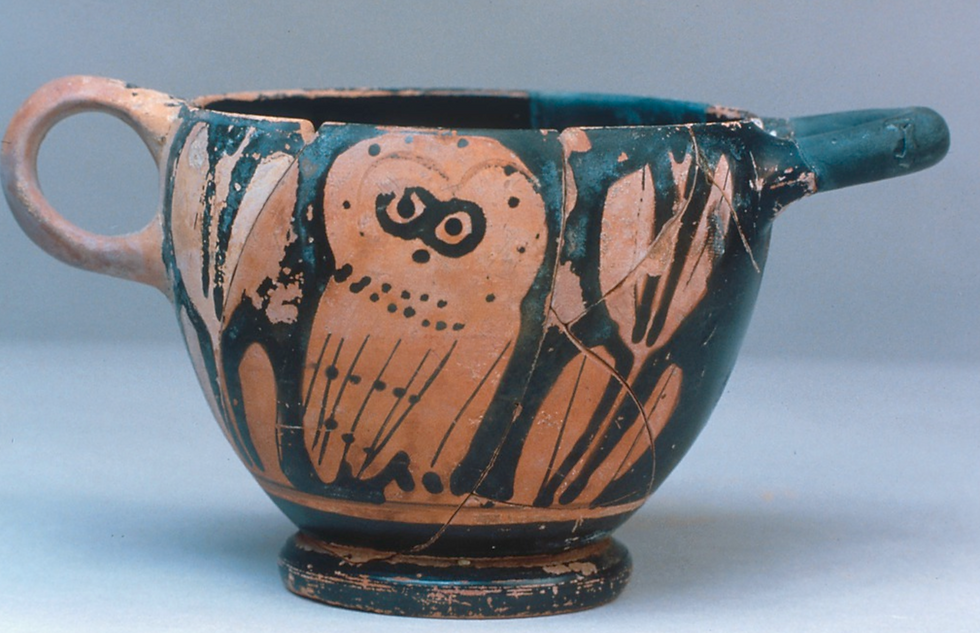
The work was no longer treasure hunting. We were after information: which coins were dropped when and where, how to date fragmentary pottery in each layer — the history of Athens told through artifacts rather than texts. Excavations have been ongoing since 1931, approaching a century. They have been funded almost entirely by private American sources, from people who value the principles of ancient Greece. Publishing is essential. So far, more than 60 books and over 450 articles have been written by more than 120 scholars, revealing what we know about Athenian life from the Agora excavations.
WORDS | JOHN MCKESSON CAMP II
IMAGES | AMERICAN SCHOOL OF CLASSICAL STUDIES AT ATHENS


